




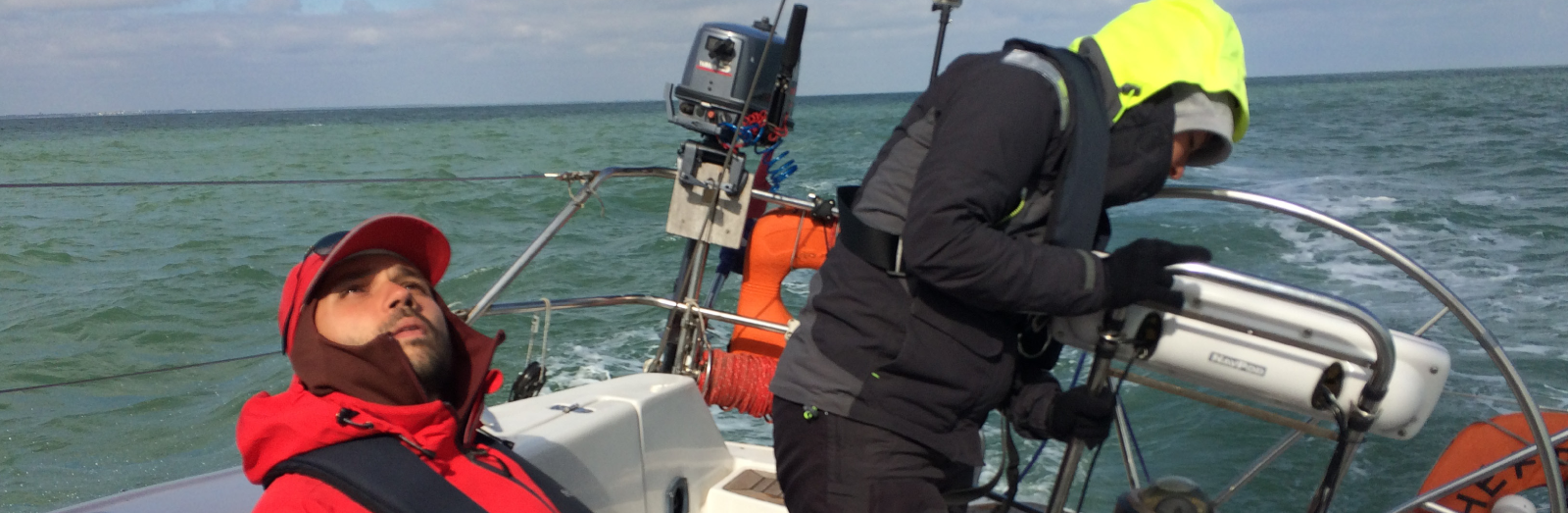


Preparing for heavy weather
The following guidelines are a sensible precursor to heavy weather
- Stow all gear securely
- Shut lockers and hatches
- Shut and secure portlights
- Stow essentials in plastic bags
- Turn off seacocks to toilets and sinks
- Mark fix on chart and secure chart to chart table
- Update log
- Check contingency plans and, if not allready done so, add appropriate waypoints to GPS.
- Prepare contingency passage plans
- Sail away from the lee shore
- Print or write out weather forecast times and fasten to the chart area
- Organise a crew roster. Rest the strongest and most able crew first
- Eat a meal and prepare sandwiches and flasks of hot drinks
- Drink plenty of water
- Charge engine batteries
- Check bilges and ensure bilge pumps are working
- Check and wear safety equipment
- Secure cockpit lockers to prevent down-flooding
- Secure washboards in companionway
- If appropriate, shut watertight doors
- Stow loose items off deck
- Prepare and secure anchor locker
- Check sea anchor and heavy warps
- Rig and check jackstays
- Close off deck ventilators
- Check cockpit drains are clear
- If required, rig mainsail reefing pennant to third reef
- Prepare trysail and storm jib
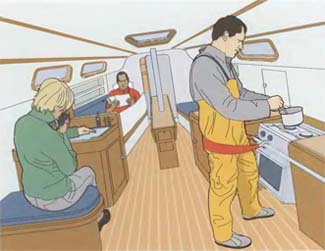
Good seamanship – prepared for heavy weather
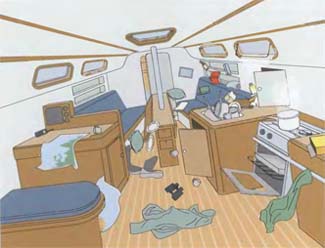
Bad seamanship – poorly stowed gear after heavy weather
Shortening sails
As the wind strengthens you need to shorten sail. Allways shorten sail before you have to because it’s easier to shake out a reef if the conditions allow than to take one in when the wind has increased.
The order of shortening sail will depend on your boat and rig. In general, the principle is to shorten sail by gradually reducing the headsail and mainsail so that the centre of effort does not move too far forward or too far aft. This will keep the boat balanced and ensures sufficient weather helm is maintained.
Note that on some boats with boats with slab or jiffy reefing only two reefing pennants are run. This requires the first reefing line to be reattached to the third or uppermost reefing cringle. Three reefs will reduce the main sail by up to 60% of its total area.
While roller head sails can reduce sail area completely, a partially reefed roller head sail is very inefficient upwind and will not provide the proper balance.
Storm sails
If wind conditions increase, you will need to resort to storm sails comprising of a storm jib and trysail. These lower the center of effort and may help a yacht to be sailed of a lee shore. They are made from heavy-duty material usually coloured bright-red or luminescent orange so that other shipping can more easily see the boat. A storm jib is best set on an inner forestay, this can be a rigged temporarily or permanent.
A trysail is a loose-footed sail. Its sheet is led aft either to a spinaker pad eye or to a stern mooring cleat. Occasionally, it may be attached to the boom but this is not recommended.
Depending on type, a trysail can allow for the mainsail to be furled and secured to the boom. The boom can then be dropped and secured to the deck. A trysail can be hoisted in the mainsail’s track or preferably in its own track. It must be securely fastened.
Both sails should be prerigged with their own sheets.
Since the rigging of storm sails differ from that of ordinary sails, it’s important to practise rigging them in fine weather rather than waiting untill you really need them. Rig them in advance of a storm.

Rigged for heavy weather. Storm jib is best set on a inner forestay while the trysail replaces the mainsail.
Breaking waves
Waves are generated by the frictional effect of wind on the surface of the water. The stronger the wind, the longer it has blown and the greater the fetch (the distance from shelter to windward), the bigger the waves.
Very steep waves are formed when:
- The wind strength increases rapidly
- Wind and current oppose each other – wind against tide
- Waves are coming from different directions due to a sudden wind shift
- Water becomes shallow
Waves break when they reach a critical steepness and gravity can no longer sustain their shape.
Compared to their size, breaking waves release enormous amounts of energy and they are often sufficient to knock down and capsize a boat.
When caught beam-on, a breaking wave the same height as the beam of the boat is enough to turn the boat upside down.
Owing to the boat´s reduction in moment of inertia, a dismasted yacht is often more easily rolled by a breaking wave than one with a mast.
Avoid areas of breaking waves whenever possible.
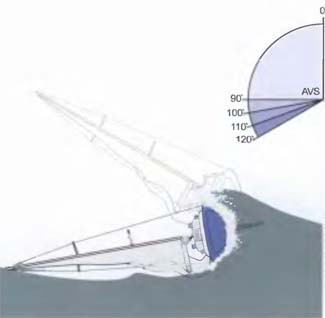
A breaking wave the same height as the beam can capsize the boat
The Angle of Vanishing Stability will depend on the design of the boat. Many will not right themselves once inverted to 120°

Many boats will stay upside down after capsize


